
Every June, something like half a million people pour into downtown Denver for Pride, and almost none of them think about the signs. They think about the floats, the bass rolling off the stages, the friend they're supposed to meet near the food trucks. The signs are what tell them where the friend is. Janeshly Algarin made the signs.
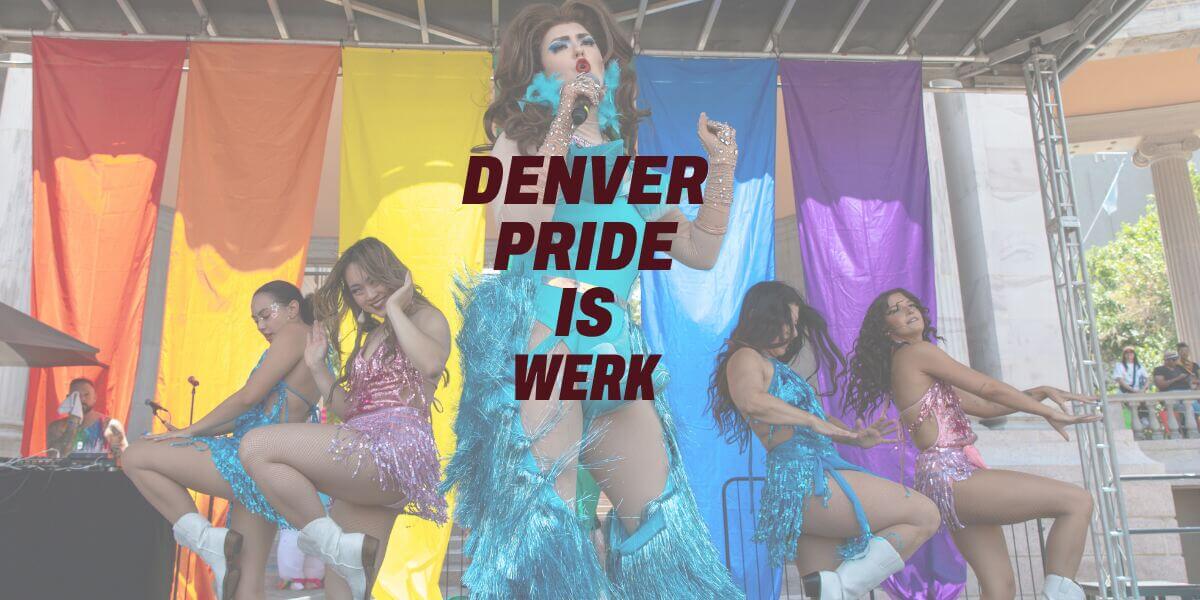
Janeshly, she/they, is a designer and a project manager at The Center on Colfax, which is to say she handles the part of Pride that nobody is supposed to notice. A good map disappears into the day. A banner over the right entrance, a clear arrow toward the Trans Oasis, a color that reads from clear across a crowded street: these are the things that keep a gathering of that size from tipping into chaos, and they are what Janeshly is thinking about while everyone else is dancing. The title here does a little double duty, and so does she. To werk, in the language of the drag stage, is to deliver, to leave nothing in the tank. The other kind of work is quieter. Pride runs on both.
She started on January 8th, in the fiftieth-anniversary year, fifty Junes on from 1974, and the season was already bearing down. Her predecessor had left, and left her, as she puts it, deep in Pride before she'd unpacked. The vacancy turned out to be a kind of gift. The organization was ready for something new, which meant a young designer with opinions had the room to have them. The first big one was the theme.
Each year Denver Pride takes a phrase. For the fiftieth, Janeshly pitched four. A couple were lighthearted; one or two sat in a comfortable middle. The community chose the one with teeth. "Hearts on Fire," the winner, was the most activist of the bunch, the angriest, in the specific sense that anger is the thing you feel when you want change and it hasn't come yet. The lighter options would have been easier to design around. She didn't seem to mind that people went the other way.
Then the elders. For the fiftieth she set out to record where all of this had come from, and sat down with people who'd been there near the start: Christie Lane, Phil Nash, a former executive director of the center. What they described was not nostalgia. It was being turned away from bars and restaurants, raising money however they could, watching people die, and learning that the drag bar was often the only place a person could actually go for help, for a meal or a bed or a word for what was happening to them. Most of those interviews live in the center's archives now; there was, she admits, more material than one person mid-Pride could ever use. The education stuck anyway. It gave her, she says, a baseline of gratitude, and a place to stand.
One of the faces of that fiftieth year was Ophelia Peaches, a young drag performer who works the center's main stage. Set beside Lane and Nash, Peaches is the evidence that the thing the elders built is still being built. Somewhere in the reporting, Janeshly did the math and realized she was now standing inside the lineage she'd been documenting.
It's the kind of realization that can make a person solemn. Janeshly is not solemn. She's the colleague who brightens a room on the way through it and then, once everyone's relaxed, says the true thing nobody wanted to go first on. Under the warmth is a spine made more or less entirely of pride, lowercase and capital both.
Her arrival is part of a longer turn. The center, she says plainly, was once read from the outside as a cis white boys' club, and the people inside it knew it. Over a couple of years, with BIPOC committees brought in to name what wasn't working and then actually listened to, it grew closer to the community it claims to be. You can see the shift at the festival's edges. The Gayborhood, the market built to make Pride reachable for small businesses, pulled in vendors who'd never had a booth before. Some had their best weekend of the year and rebuilt their whole operation around the queer customers they met, coming back the next June as full exhibitors.
She lights up about the parts of Pride designed for people Pride used to leave out: an indoor space for anyone immunocompromised who can't do six hours in the June sun, a doggy drag show for the leashed contingent, events shaped around specific communities instead of assuming a single one. And she's quick, insistent really, that almost none of it is her doing. The full-time staff is small. The festival is carried by volunteers, some of whom have been showing up since close to the beginning, and who will be out there again this month doing the unpaid, unglamorous, load-bearing work of it. That, too, is werk.
It matters because of where the money goes. Denver Pride is the fundraising engine for a working nonprofit, and the proceeds don't evaporate when the stages come down. They turn into the center's year-round services: free mental health care, support for trans Coloradans, programs for queer kids and for elders, the life-affirming and occasionally life-saving stuff that never makes a flyer. Which returns Janeshly to the question she took out of those archive interviews and never quite set back down. With everyone rainbow-washing and arguing over language, how do you bring it back to the foundation, which was always justice.
This year you can answer that with your feet. Denver Pride looks different in 2026. Civic Center Park is under construction, so PrideFest has moved downtown to the 16th Street promenade and condensed into a single, high-wattage Sunday, June 28th, ten to six, free to walk into. The Vizzy Denver Pride Parade steps off that morning at 9:30 from Capitol Hill, running 17th Avenue from Franklin to Lincoln, and lets out about a block from the festival gates. Events have been filling the city all month leading up to it.
When you get there, take a look at the signs. Someone werked.