
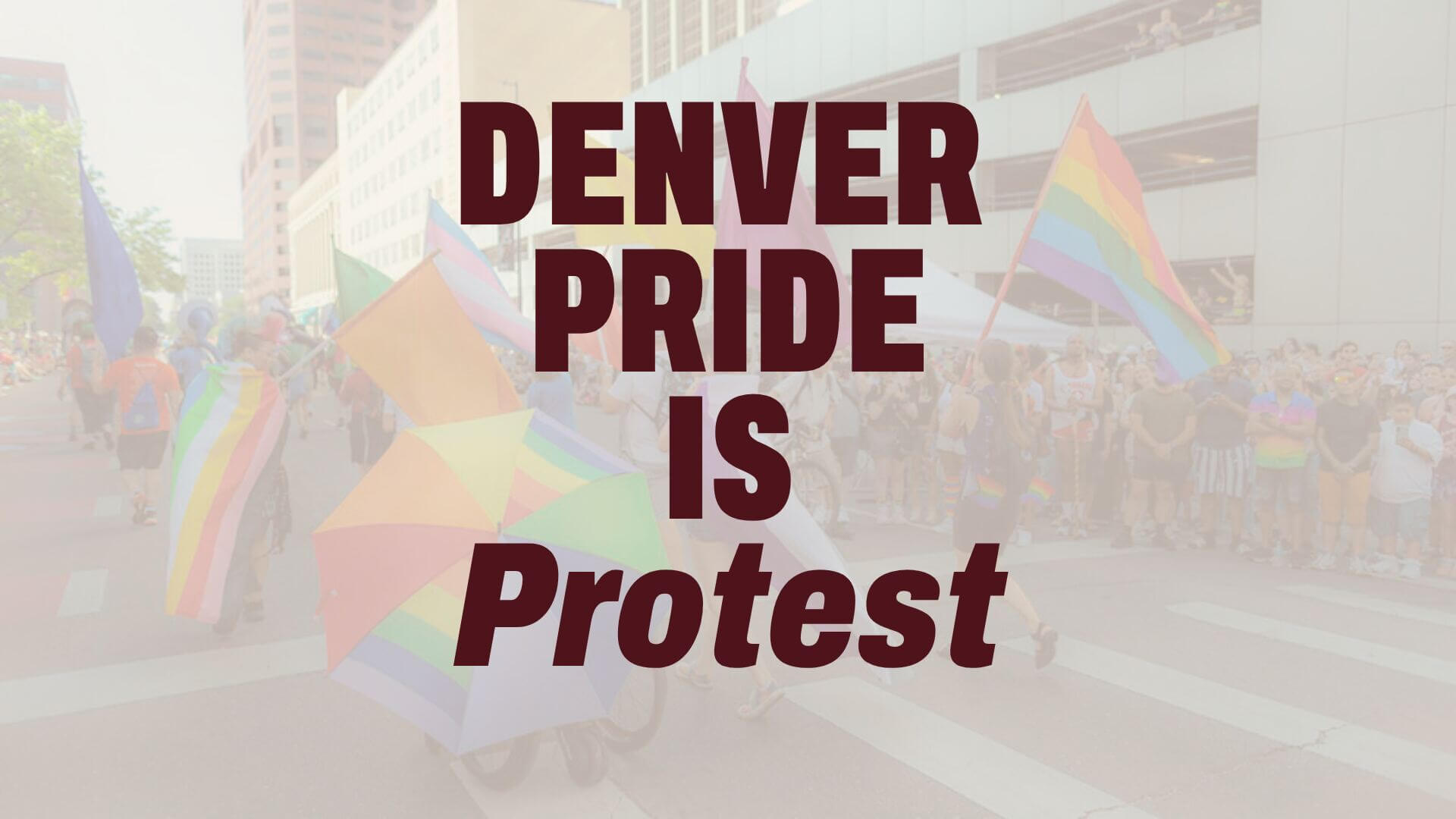
Every June, when the Denver Dyqe March runs short on something — a megaphone, a wagon to haul water, a first-aid kit gone stale — Jennifer Vaught posts a wish list and waits. It goes out on Facebook, on Instagram; the supplies show up at her door, addressed to her by name, bought by people she will mostly never meet. In eighteen years, the march has never taken a sponsorship dollar, never fundraised, never, as she puts it, touched a single dollar.
"Everything that we do, everything that we use, everything that we get is donated by the community," she told me.
This is, for Vaught, the whole idea.
I asked her what it means to say that Pride is a protest, and she answered without hesitating: "Everything."
In 2026, Vaught's sentiment rings as true as ever.
The ACLU tracked 575 anti-LGBTQ bills in state legislatures in 2025 — the sixth record-breaking year in a row — most of them aimed at transgender people, with hundreds more filed in 2026. They would bar trans people from public bathrooms, cut off gender-affirming care, and, in some states, write a definition of sex into law that erases trans and nonbinary people from its protections altogether. The targets sit mostly in other statehouses, but they land on the same community Vaught has given her life to.
She has been involved with Denver Pride for twenty-eight years now — long enough to have done nearly all of it, from watching on the sidelines to marching with organizations to sitting on the Pride committee to running the Dyqe March, both inside Pride Fest and, in 2020, alongside it.
"We exist 365 days a year," she said. "Pride is our platform to elevate and raise our voices to be heard." The festival, in her framing, is the platform — not the point.
Denver Pride began as a protest, on the ground, in Cheesman Park. The first gathering, in 1974, drew about fifty people and a few balloons that read "gay pride," and it came after two years of organized fury at the Denver Police Department, which had been entrapping gay men through an undercover sting it ran out of a tour bus dressed up as a Johnny Cash concert promotion.
Between January and March of 1973, more than two hundred and fifty men were arrested that way. Jerry Gerash, an attorney and one of the movement's founders, sued the city and won; the court barred the police from enforcing the law against gay people any differently than against anyone else. The first parade came the year after. To call yourself gay and proud in that Denver, Gerash has said, was to reject all four of the things you'd been told you were — sick, sinful, illegal, unpatriotic — in a single breath. It was celebration and protest at once. Vaught is insisting that breath has not changed.
The Dyqe March is its own strand of that history, and it did not begin as a celebration either. It started, nationally, in the late 1980s, out of grief and fury over the AIDS epidemic — a time, Vaught said, when "we were watching our brothers die without care and without representation."
Women in the community grew tired of watching men go to the wayside while the country looked away.
They took to the streets. The march was an act of noise, a way to force a conversation the rest of America would not have: about the men in the hospitals, the men who needed someone to show up. That is the lineage Denver inherited.
Decades of progress
It arrived here almost by accident. The woman who started Denver's Dyqe March, a community member named Patty, had cancer; she died two weeks before the first one, in 2009.
Vaught, hired that year only to emcee the rally at Charlie's, found herself holding a march in a dead woman's honor. She assumed it was a one-time thing. Then, The Center and the Pride committee called.
"We can't just stop at one year," they told her. "What do we do?" She worked out the logistics with the Pride committee, then never quite handed it back. Eighteen years later, she is still on the committee.
The community she started in looks very little like the one she works in now. In the early 2000s, she described a kind of quiet self-segregation — lesbian bars and gay bars, a Dykes on Bikes chapter, transgender and nonbinary people present but dispersed, rarely seen.
Denver's march set out to gather the people Pride Fest tended to leave at the edges. Somewhere along the way the spelling changed, from D-Y-K-E to D-Y-Q-E, an acronym a younger generation on the committee built for itself: Diverse Young Queer Empowerment. "We're the rebellious children of Dyke March," Vaught said. The point was never women only. The point was everyone who felt forgotten. Intentionally or otherwise.
Turning Capitalism into Activism
Denver Pride funds The Center on Colfax. When you buy a ticket to a Denver Pride event, you are supporting free, year-round services for queer youth, elders, transgender people, and so many others who have nowhere else to turn. And our sponsors who make the festival possible also keep our doors open the rest of the year.
Voices like Vaught's have pushed The Center to be more deliberate about that arrangement — not simply whether to accept sponsorship, but who we choose to accept it from.
The Center has listened. In recent years it has grown more intentional about the partners it takes on, treating sponsorship less as a transaction than as a way to turn corporate money toward the work of the community. This year's parade carries a sponsor's name — the Vizzy Denver Pride Parade — and leads crowds to the free festival on 16th Street. Celebration and protest are both on full display at our parade.
Vaught's point is more generous than a simple objection to corporate cash. She understands the need for the money — she helped start Rainbow Alley, the Center's youth program, in 1998, and knows what it costs to keep open.
She points to 2020. That summer, amid a national reckoning over racial justice, Vaught and a handful of other leaders built Pride Liberation — an event that drew one of the largest in-person crowds in Denver Pride's history, organized in collaboration with, but distinct from, Pride Fest, with BIPOC voices at its center. Out of it grew Black Pride Colorado, which now runs thriving events on direct community engagement. For Vaught, it's proof of what the community can build together — and a model The Center has taken to heart as it shapes what comes next.
On June 28, both versions of Denver Pride will share a single day. The Vizzy Denver Pride Parade will move first, and the free festival on 16th Street will honor 52 years of Pride as a protest.
Denver Pride traces a straight line back to those fifty people in Cheesman Park, and it is proud to carry the protest inside the celebration rather than scrub it out. Vaught sees the whole thing as a conversation the community keeps having with itself — about who funds liberation, who it serves, and what is owed to the people who marched when there were no sponsors and no stage.
That breath feels close this year. Denver Pride in 2026 arrives against the steepest legislative backlash our movement has seen in modern history.
It is why the word "protest" has stopped reading like history. Cheesman Park in 1974 answered a government that wanted gay people gone; the same answer is being written again, now.
"We're not just here to help corporations make money during June," she said. "The festival is the celebration. The protest is the reason there's anything to celebrate."