
A note from the author: Denver Pride Is __ brings our community behind the scenes to meet the people who make Pride happen, from those who organize the 550,000-person event we know and love today, to the folks who gathered in Cheesman Park to protest homophobic law enforcement.
This piece of our series is much longer than the others. 50 years of history was hard to capture in even 2,000 words. These stories from Phil, Jerry, and Christie give me hope far beyond the next five decades.
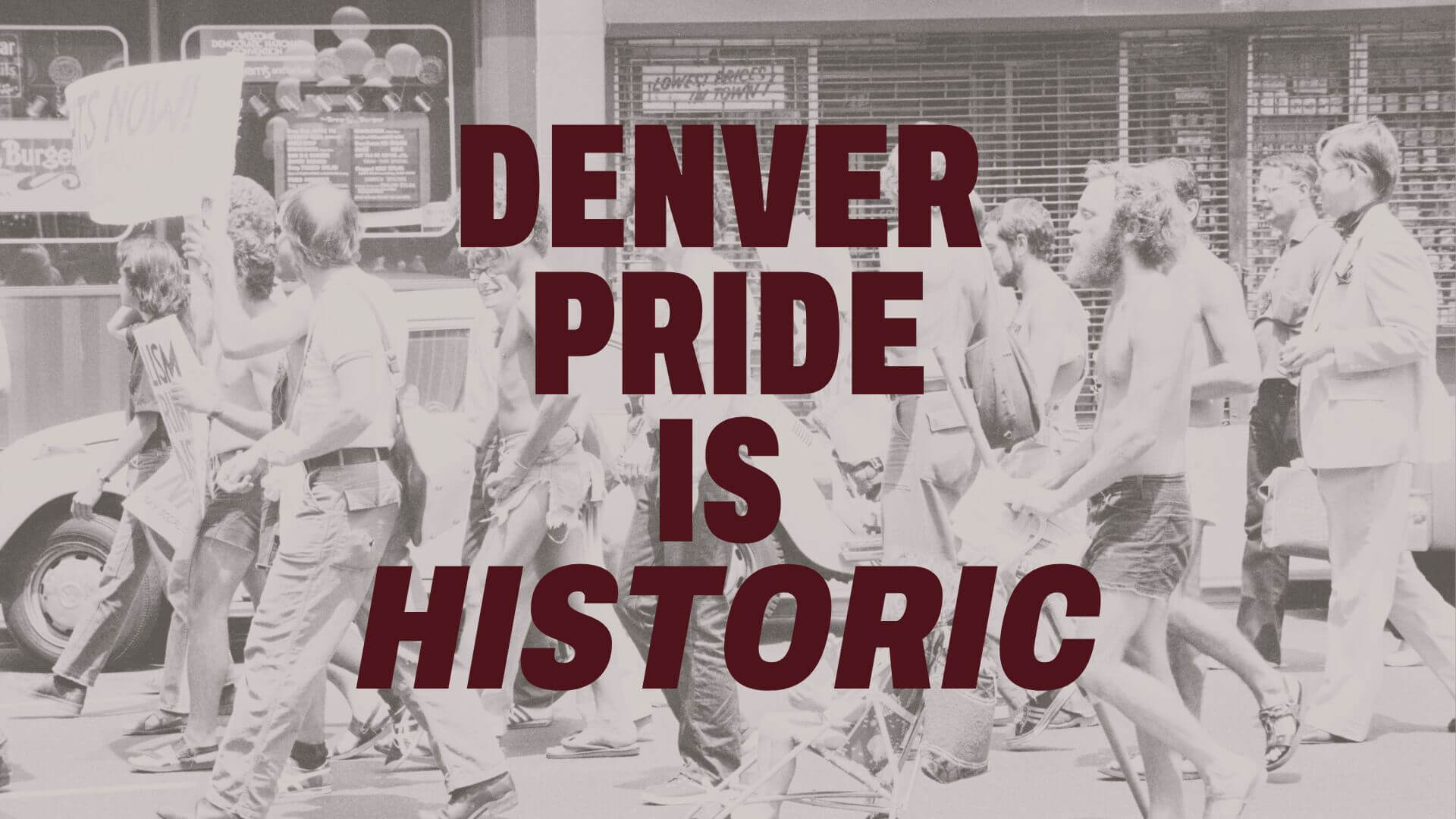
Denver Pride Is Historic
Before we had half a million people gathered in Downtown Denver the last weekend every June, there were about 50 people and some balloons in Cheesman Park.
This was 1974. The balloons said "gay pride" on them, which at the time was either a radical statement or a punchline, depending on who you asked. Jerry Gerash, who had helped organize the thing, would have said it was both. He was thirty-nine years old, an activist who had spent the better part of two years dragging the Denver Police Department into court over what it had been doing to gay men in this city.
"And they were doing whatever they wanted," Jerry recalled. "Didn't matter if it was legal or not."
Fifty years later, half a million people come to Denver Pride every June.
Jerry is ninety-two now. He sat down recently with Christy Lane and Phil Nash — two of the handful of people still living who were present at the beginning — to talk about what they built, what it cost them, and what they make of the world they helped create. The conversation moved the way old friendships do, looping back on itself, finishing each other's sentences, laughing at things that had stopped being funny a long time ago and then became funny again.
Where it all began
Christy Lane came to the movement through the Imperial Court, Denver's drag and performance royalty organization, which had existed since 1973 and operated, as Christy describes it, on the principle that being yourself in public was its own form of political activism. She traveled to San Diego as a court member and came back with papers outlining what a gay and lesbian community center might look like.
Before the first parade in 1975, she went club to club — Denver had eleven gay bars at the time, which existed largely, as Jerry puts it, because the city believed they would keep gay people out of the parks — explaining pride to anyone who would listen.
"Our depth of knowledge," Christy says, with the particular dryness of someone who has had fifty years to find it funny, "was about as deep as a teaspoon."
That teaspoon of knowledge was enough to start the movement that became Denver Pride and The Center.
Phil Nash arrived in Denver in March of 1976 with his now-husband Bob Janowski, fresh off a bicycle trip through Europe.
The two were “broke but in love,” and ready to settle down. He found an announcement about Unity meetings in a local publication, called Jerry, was told that Unity was an organization of organizations and not for individuals, and showed up anyway. Jerry told him he was welcome to attend as an observer. This is, it turns out, a reasonable summary of how most of the movement got built.
To understand what they were fighting, you have to understand what Denver looked like in 1972, when Jerry and four others — Lynn Tamlin, Mary Sassatelli, Jane Dundee, and Terry Mangan — founded the Gay Coalition of Denver in their homes. Colorado had just repealed its sodomy laws, but the Denver Police Department continued targeting gay men with a methodology that ranged from raiding bars and arresting people for dancing to deploying undercover officers whose job was to initiate sexual conversations with gay men and then arrest them for agreeing to what they believed was consensual sex.
To be gay then, Jerry says, was to be told you were four things: sick, sinful, illegal, and unpatriotic.
To call yourself gay and proud was to reject all four labels simultaneously. It was both celebration and protest.
Some things never change.
Unrelenting police
In January of 1973, the Denver Police Department introduced a large tour bus with a marquee that read "Johnny Cash Special,” and drove it through the gay cruising areas of Downtown Denver. The driver stood outside and invited men on board with the promise of free concert tickets. Once inside, he solicited them for sex. When they agreed, uniformed officers appeared. The men were told to lie quietly in the back while the bus circled for more. Between January and March, over 250 gay men were arrested this way, charged with "making a lewd offer" for agreeing to a proposition that a police officer had initiated. Records would later show that 100% of lewdness arrests in 1972 and 1973 were gay men.
Jerry, then an attorney who had been waiting for exactly this kind of evidence, filed a civil lawsuit.
The Coalition's response was methodical and, for a group that had never done anything like this before, remarkably sophisticated. They printed leaflets, hosted lectures, held press conferences, called councilmen, sent speakers to schools and universities.
They pushed for four specific city ordinances: laws against loitering for sexual deviant purposes, renting a room for sexual deviant purposes, lewd acts, and cross-dressing.
On October 23, 1973, Jerry and the Coalition brought 300 community members to Denver City Council. The chamber was standing room only. People had waited for hours. City Council President Robert Koch gave them thirty minutes for thirty-six speakers and made clear, gesturing toward the three sheriff buses parked outside, that disruptions would be met with arrest.
Two councilors — Irving Hook and Elvin Caldwell — eventually moved to extend the meeting until 1:00 A.M. so that everyone could speak. As the statistics came into focus, the council grew more receptive. At the next meeting, on November 12, they repealed two of the four laws. On November 19, they repealed the other two.
In 1974, Jerry won the civil lawsuit. The court ruled that police could not enforce laws in a discriminatory manner against gay people — and went further, prohibiting officers from arresting gay and lesbian people for public acts of affection that they would permit among straight couples. The Denver Police Department appointed a liaison to the Gay Coalition, the first LGBTQ+ police liaison in the state. An activist in San Francisco gave seed money to continue the work.
Small, scrappy, and determined
The year was 1974, and The Gay Community Center of Colorado began as a small office on Pennsylvania Street. There was a library with about three shelves of books. In 1975, Jerry used the donated money to convene Unity — bringing together nine gay and lesbian organizations, including the Metropolitan Community Church, the Rocky Mountaineers motorcycle club, and the Imperial Court. The idea, as Jerry described it to those first attendees, was simple: no single group could build a community center alone. They needed a mass base of support. He called the umbrella organization Unity because, as he saw it, embedding the concept in the name meant every time anyone said the word, they would reinforce who they were and what they were trying to do.
At the time, Jerry remembers, the word “transgender” was hardly in anyone’s vocabulary and the word “queer” was a deeply offensive slur. That meant gays and lesbians – some of whom were gender-nonconforming and may identify within the genderqueer umbrella today – held the reigns, even though they didn’t have today’s terminology to describe identities.
In September of 1976, Christy organized a two-day retreat at The Bunkhouse, a gay-owned inn near Breckenridge, that functioned — as Phil describes it — something like a constitutional convention. Twenty-two people attended. They built a governance structure. They agreed on programs. They debated a name: the delegates from Fort Collins, who had driven down from a Gay Alliance housed at Colorado State University, argued that the center should belong to all of Colorado, not just Denver. The group agreed. They incorporated in November as the Gay Community Center of Colorado. By 1977, thirty-nine groups were associated with what would become The Center on Colfax.
Then AIDS came, and this is where the conversation slows.
"I don't think any of us can adequately tell you," Phil says, "how profoundly and deeply affected we've all been."
The disease took most of the people Jerry thought he’d grow old alongside.
It also took the infrastructure. Money, time, leadership, and energy were directed away from making strides towards gay liberation and towards gay survival. The center nearly collapsed. For years it operated out of a borrowed office at St. Paul's United Methodist Church, a block from where it had been.
"There are holes left in my life," Jerry says, "that have never been filled."
What often gets left out of the AIDS story is who showed up. There had been real tension between gay men and lesbians in the early years of the movement. Some misogynistic gay men refused to work with lesbian feminists, and some lesbian separatists felt divisions were too rigid to overcome.
And then AIDS arrived, and the divisions largely dissolved.
"They supported gay men," Jerry says, "and they really came forward." He remembers his friends — Linda Rose, Sue Legaris, and many more. They hugged gay men, drove them to doctor’s appointments and squeezed their hands when no one else would even glance in their direction.
Christy saw the same thing from his then-home in California, where lesbians married gay men so they could get on their insurance.
If infected men were to survive the disease, their lesbian wives believed they deserved a life of dignity.
“If we didn't have them," Jerry says. He doesn’t finish the sentence.
He doesn’t need to.
The epidemic also cracked open The Center in ways that, in retrospect, were overdue. So many gay men who had been in leadership and staff roles were gone, and women stepped in — not just to fill gaps, but to lead. Three women were elected to the board in a single cycle. The Center that emerged from the AIDS years was a different institution than the one that had entered them. It was more inclusive, more complicated, harder won. We carry those lessons into today.
The Colorado AIDS Project, which the center had helped found, grew so quickly it spun off into its own independent organization.
What strikes you, listening to Phil, Jerry, and Christy talk about Pride now, is how genuinely surprised they seem by it. Half a million people. A month of events. Dykes on Bikes and straight families with strollers and people in their eighties who remember when there were fifty people and some balloons.
"There is nothing more diverse than that event," Phil says. "All ages, all sorts of expressions of fashion, ways of being."
Christy thinks about the people who show up every year being exactly and unapologetically themselves.
"They were the magic," she says.
Phil has a theory about the straight families.
"I think a lot of straight people are jealous of what we've got," he says. There is something at Pride — a collective permission to be fully yourself in public, to take up space without apology — that is genuinely unusual. The people who had to fight for it understand its value in a way that is difficult to explain to people who have always had it.
Phil has lived long enough now to hold the whole arc of it. He remembers standing at a podium at a national conference on families during the Carter administration and arguing that same-sex marriage could one day be possible, and that day could be within his lifetime. People looked at him like he had lost his mind.
In 2015, the Supreme Court agreed with him.
He takes that lesson – things that seem impossible one day are within reach later.
"As dark as things may look right now," he says, "it's not the first time things have looked dark for any of us. We have weathered police harassment. We have weathered AIDS. We have weathered constitutional attacks on our rights. And we come back stronger every single time."
Pride then and now
Since Pride’s inception, every dollar has gone to help LGBTQ+ people through The Center’s life-affirming, year-round support.
“Pride is the largest supporter for LGBTQ small businesses and employees who dramatically changed corporate American policy to be more inclusive,” said David Duffield, LGBTQ historian.
Every dollar spent at Pride – which has evolved into an entire month of celebration – is returned to The Center on Colfax, Colorado’s largest LGBTQ community center.
“Pride is the largest caretaking event to share resources, and that’s LGBTQ mutual aid,” David added.
Jerry, at 92, is still thinking about the gap between the older generation that was wounded by the word "queer" and the younger generation that has claimed it as their own. "It can only be closed through communication and interaction," he says.
Their advice to the next generation is simple, and they say it in almost the same words: volunteer. Show up. Go through whatever doors are open.
"The thrill of my life," Jerry says, "has been as an activist." Christy nods. Phil thinks about the 20% of doors that are always open, even when 80% are closed, and says: go through those.
A note on living history
I came to these conversations thinking of myself as a storyteller — someone with a notebook and a job to do. What I didn't expect was to sit across from Jerry Gerash at 92 years old and feel like someone had fought for me before I even knew I needed fighting for. Like the ground I stand on didn't appear out of nowhere. Like I have ancestors.
Because, as a transgender person, I have my LGBTQ ancestors to thank for the rights I have today. Our identities may differ, but our fight is the same. Our liberation is intertwined.
These stories can feel like ancient history. They are not. The people who built this community are still alive. They remember the bus with the marquee that said "Johnny Cash Special." They remember the names of the friends AIDS took. They remember what it felt like to say the word "gay" out loud in public and mean it as something proud.
And they built something anyway. In the middle of harassment and grief and a government that wanted them gone, they built something that half a million people show up to every June. Something I showed up to, before I even had the words for who I was.
I am so grateful to now have the privilege of sharing their story with you.
I won't pretend things aren't hard right now. They are. But I've spent weeks with people who have dedicated their lives to fighting for all of us, and I believe them when they say we come back stronger after every battle.
And history is on our side.
Because love beats out hate. Every. Single. Time.
This year, Denver Pride adds a new chapter, and I want you to be part of it.
On June 6, The Center on Colfax is hosting Love Wins at the Palace — an inaugural Pride gala at the Brown Palace Hotel and Spa, where the chandeliers are original and the atrium soars nine stories above the lobby floor. A champagne reception, a multi-course dinner, live jazz, a charitable auction. Elegant attire with a touch of sparkle encouraged.
Every dollar supports The Center's free year-round programs — the youth support, the mental health resources, the elder care. The things that, for a lot of us, make the difference between surviving and actually living.
I hope you'll come with me.
Get your ticket at denverpride.org/events/love-wins-at-the-palace.