
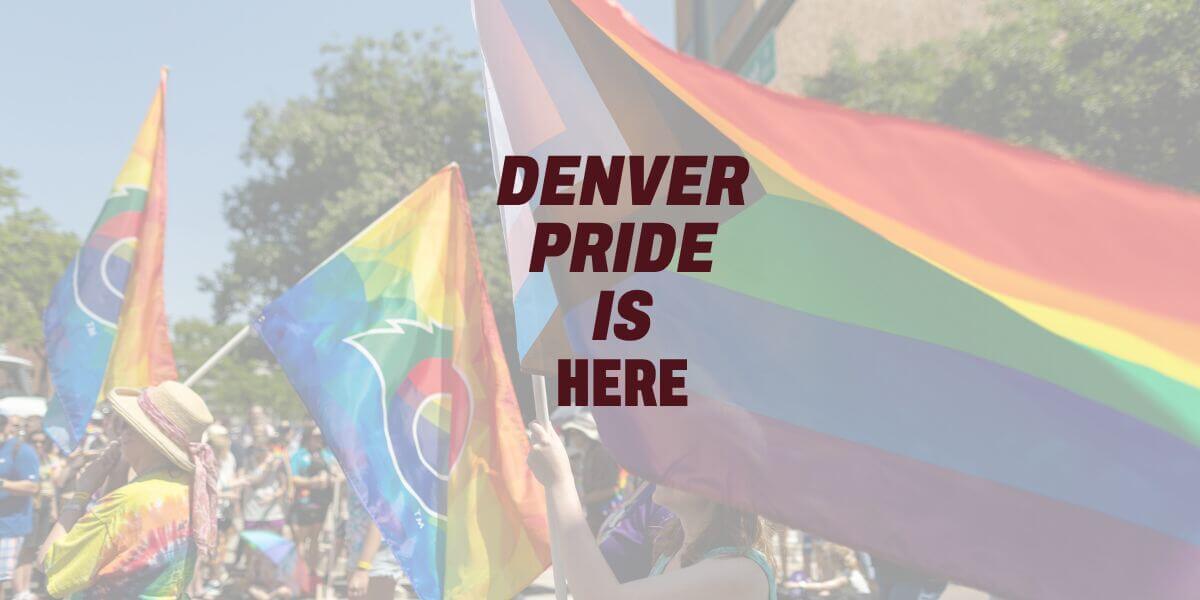
Denver Pride Is Here
There was a year, not so long ago, when Maya Blasingame stood at the gate of a Pride festival and could not make herself walk in. She was presenting as a man at the time. She had bought a few things at Ross for the occasion and done her makeup, and she had told herself that this would be the day she crossed some line she had been circling her whole life.
Instead she stood at the fence. By the time she worked up the nerve, the festival was ending. What she remembers is not the disappointment so much as a stranger she met afterward, walking downtown — another trans woman, who looked at her and said, simply, that she was pretty. It was the first time Maya had heard it as herself.
She is thirty-one now, and she tells this story the way you trans people often reckon with previous versions of ourselves. Not wrong, but not us.
"I always call it a past life," she says.
Maya grew up in Santa Clarita, north of Los Angeles — a place she describes as conservative. There was no community center there, no Lavender Hill to walk through. There was a GSA at her school, but the kids in it got bullied, so she kept her distance from that, too. What she had instead were fragments, smuggled in early and held onto: her grandmother's lipstick, which she would put on at three years old,
"Living my Janet Jackson fantasy,” she remembers.
Her mother's clothes, which she collected in her closet; the Saturday mornings she woke up early for the Looney Tunes episodes where Bugs Bunny dressed in drag, because, she says, "I was like, oh my gosh, I want to do that. I see myself in that."
She did not have the word transgender yet. She had the recognition, which came long before the vocabulary.
She was also, in the language of her hometown, a jock — a basketball player, buff, popular, exactly the kind of boy people wanted her to be.
But the performance cost her. "I think I'm owed an Oscar," she says, and the joke is doing the work jokes do, which is to hold something heavier at arm's length. The heavier thing is this: she is a survivor. She tried to end her life as a child, and for years she went to bed praying she might wake up as a girl. The prayer did not come true; she survived anyway, mostly in private, mostly alone.
What changed was geography and medicine, in that order. She moved to Denver in 2014 to help care for her grandfather after his Parkinson's diagnosis, and it was here that she began to let herself look directly at the question of who she was. Around twenty-four, she started hormones. She remembers the first estradiol tablet she placed under her tongue.
"Everything made sense," she says. "I didn't want to kill myself anymore. It was instantaneous."
She says it plainly, because it is plainly true to her, and to so many of us: gender-affirming care saved her life.
She came out publicly in 2020, in the summer of the George Floyd protests, which she was heavily involved in.
With a group of other trans organizers, she helped stage one of the first marches for trans rights in Colorado history, and she stood on a stage and spoke as herself before she had even chosen her name.
Some people fell away after that — family, a cousin she still rarely speaks to. But the wider circle held, and in the holding she found a different kind of relation, the one she now organizes her life around: chosen family.
"Chosen family are the people that show up for you and reciprocate the energy you give," she says
And anyone who knows Maya knows she’s the embodiment of showing up. If you’ve ever been to a protest, an organizing event, a queer festival, Maya is there. With a hug, and a smile, and an impressive memory of your name even if you’re not sure where she learned it.
The people she has gathered since are the ones who treat that instinct as a gift rather than a resource to be drained. Her partner, Amanda, who has been beside her since the beginning of her transition. The friends she can call on a bad day and know someone will answer. The relationships, including the polyamorous ones, that she describes not as arrangements but as a practice of wanting other people to flourish and being wanted that way in return.
"Making friends as an adult is hard," she says. "But it's worth the work. And I always say you're worth the work that you've put in."
Her grandfather died in April of 2022. She had made him a promise: if he chose to go, she would move back to Denver and look after her grandmother. Within two weeks she had packed up everything she owned in Redding, California, and come home. A few weeks after that, grieving, she went to her first real Denver Pride.
This is the part of the story where the gate finally opens. She walked in with both her partners. She sat in the grass with her flag. She found the main stage and danced, and she watched Felony Misdemeanor — a legend of this city's drag scene — and thought: if she can be up there, so can I. "When you're around people that look like you, that talk like you," she says, "it's transformative. I felt like I was finally at home."
These days Maya is one of the community voices the Center on Colfax has been bringing to the table as it remakes what Pride can be — divesting from sponsors the community had long objected to, asking the people it serves what they actually want rather than guessing. She does not pretend the past was uncomplicated; people protested this Pride for years because they did not feel seen by it. What moves her is that, this time, somebody listened. "Pride does feel like it's mine," she says.
That is also, more or less, the thesis of this year's Pride. The month sprawled in every direction, on purpose, so that almost anyone could find a door their size.
And Maya, who has protested Denver Pride in years past, is now proud to join us.
Whatever Pride has meant to you this June, this is the part where you show up for it one more time.
"Pride is whatever you want to make it," Maya says. "Pride is autonomy. Pride is making the choice to choose yourself, and being around other people who have done that as well."
She would know. She is the woman who once couldn't get past the gate — who now throws her own pool party every June because she knows how steep the price of admission can be, and she wants more doors, not fewer. Denver Pride is hers.
If you or someone you love is struggling, the Trevor Project (1-866-488-7386) and the 988 Suicide & Crisis Lifeline (call or text 988) offer free, confidential support, and the Center on Colfax connects community members to LGBTQ+ affirming care year-round.