
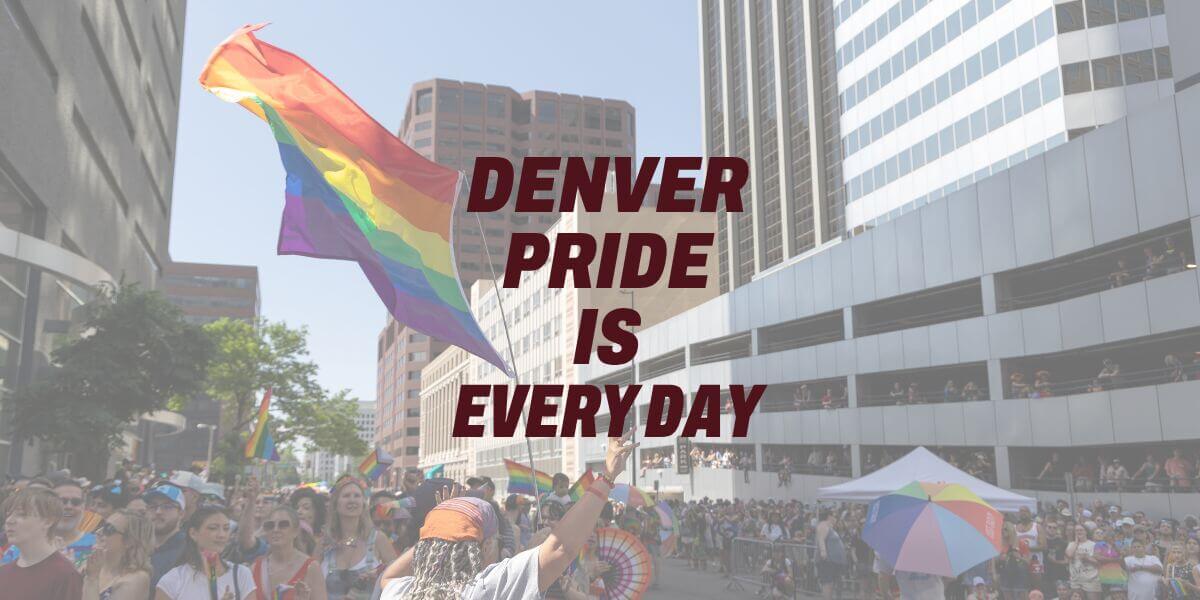
This was my eighth Pride — my fifth in Denver, and my first on this side of things. As I walked the parade route down 17th Street, gathering accounts from cheering families and happy couples and big tangled friend groups, one story caught and held me. Daniel Kirk, 26, sat outside Hamburger Mary's watching the trucks and floats roll past — rainbows flashing, candy and flags and branded trinkets flying from the hands of everyone marching.
It was Daniel's first year watching the parade as himself. As Daniel: a transgender man who has always been Daniel, and who the world is only now learning to call by his name.
We got to talking about where we grew up, about transition, about the long road to becoming someone other people can finally see. And Daniel's story pulled me back into my own.
Before I was the man I am now — out and proud, with a job that exists to lift up my own community — I was a teenage girl in a strict religious household. I got bullied for being a tomboy who never figured out how to apply eyeshadow, or which dresses went with which shoes. I was a kid who didn't yet have the words for why none of it fit.
I still remember my first Pride. My high school friend group of four straight girls and one gay boy talked me into sneaking out of our quiet suburb and driving 30 miles into San Francisco. I remember all of it: crossing the Bay Bridge into a sea of rainbows breaking through the fog, climbing the steep hills to Castro Street — one of America's most famous gayborhoods, the home of the late Harvey Milk.
We wandered blocks of tents — affirming businesses, local makers selling rainbow earrings and t-shirts that read "Gay is Good" — until something off to the side stopped me cold: a small tent with a sign that read "Transgender Resources of the Bay Area."
It was June 27, 2015, one day after the Supreme Court ruled in Obergefell that the freedom to marry was fundamental and constitutionally protected. The whole country was celebrating, and Castro Street, one of the world's most famous gay landmarks, was loud.
But standing in front of that tent, I understood something I couldn't have explained then: the celebration didn't quite reach me yet. Trans people were largely relegated to being societal punchlines, when we were discussed at all.
I drifted away from my friends. A woman with soft eyes and a trans-flag scarf saw me, a 16-year-old hovering at the edge of her table, and gently handed me a brochure of resources for LGBTQ kids and their parents. I turned the pages. Different ways to be trans. How a parent might love a child through their questions. And I cried, right there in the middle of all that joy, because I knew that conversation was one my parents and I wouldn't have for more than a decade, and because I'd had to sneak 30 miles from home just to stand close to it.
That high school friend is married now, and I'm living a life that 16-year-old at the resource tent could not have let herself imagine: communications manager for the largest LGBTQ center in the region, surrounded by queer friends who spent all month cheering me on.
This was my second Pride where every single person in my life knows me as Alec. I'm almost a year on testosterone, and it feels easy. It feels natural. It feels like I've always been him, and the world is finally getting to meet him.
It's been 11 years since I flipped through that brochure on Castro Street.
My mother called me "Alec" for the first time two weeks ago.
And then I woke up to today's news: the Supreme Court ruled that states can bar transgender athletes from girls' and women's sports.
I thought about Daniel. About the matching smiles we'd worn on the parade route — two trans men marveling that we'd both finally arrived at a Pride where everyone sees us as we'vealways seen ourselves.
Then I thought about the kids that this ruling reaches before they ever get to feel the joy that we do. Kids who won't get to learn what I learned at 16: that you are not the only one. That there is a community awaiting you with open arms when you're ready to meet them.
I thought about my friend Maya Blasingame, a trans athlete who has hosted basketball games to support trans youth alongside the ACLU. She understands something the people writing and enforcing these laws never bothered to learn: for a kid still working out who they are, a sports team can be the first place they ever belong.
And the supposed threat is so small it would be funny if it weren't so cruel. As One Colorado Executive Director Nadine Bridges so eloquently put it, "No child should have to defend their own humanity or prove they deserve the same opportunities as everyone else."
There are also very few trans kids playing sports (numbers vary depending on the source and the true metric is difficult to track, but all sources agree the number is miniscule.) The trans athletes who do compete are not dominating, either. Lia Thomas — the name anti-trans groups reach for every time — tied for fifth place with a cisgender swimmer.
So no. This was never about fairness, and it was never about protecting women and girls. It's about control. Control over our bodies, our joy, the names we answer to. Over who gets to exist out loud, without apology.
This June, Denver Pride filled an entire month, with a hike, a book fair, a reimagined free festival. But Pride is one month out of twelve.
Here's what the other eleven look like. Most days, someone walks through our doors who didn't come from down the street. They drove in from another state — from somewhere that has spent the last few years deciding people like us are a problem to be legislated, somewhere staying started to feel impossible.
They cross county and state lines the way I once snuck across a bridge at 16: because they need a place that will simply see them, for a youth drop-in, a support group, free therapy. The Center on Colfax is open on the ordinary Tuesdays nobody throws a parade for. That is the protest. That is the work.
So we keep the doors open. For Daniel, who waited 26 years for a Pride where the world finally calls him by his name. For the kid at the edge of some other crowd today, seeing their future embodied in happy, queer adults.
Pride isn't one month. It's the quiet, unfinished work of the other eleven. It's the daily decision to keep showing up as ourselves in rooms that would rather see us defeated.
We don't come out once.
We come out again every morning, and we keep coming out until the kid hovering at the edge can walk in without having to be brave.
The Center on Colfax is the largest LGBTQ+ community center in the Rocky Mountain region and the producer of Denver Pride. For 50 years, we've provided year-round programs and services — youth and older-adult programs, mental health support, legal clinics, and more — to Colorado's LGBTQ+ community, all for free. Visit us at 1301 E. Colfax Ave., Denver, ordonate, volunteer, or check our calendar here.