
For 50 years, Julia Condolora carried something she couldn't name. She knew the person staring back at her in the mirror didn't match the one she felt herself to be, but she lacked the words or even the concept to explain why.
"I thought I was just a weirdo," she remembers.
She was assigned male at birth, grew up with no framework for what she was feeling, and came of age in an era when LGBTQ+ spaces were largely limited to gay bars that didn't feel like her scene. Transgender representation, to the extent it existed at all, was a caricature. There was no language, no community, no mirror that reflected who she actually was.
So she kept quiet. For 50 years.
"I was literally in the closet, cross-dressing in my closet — and metaphorically trying to keep this a secret."
It wasn't until 2004, when Julia was 50 years old, that she stumbled onto an anonymous online chat board called Susan's Place Transgender Resources — and read a word she had never thought to apply to herself.
Transgender.
"It was amazing, because I finally had a word," she says. "I knew exactly what was going on, and I kind of started seeing other experiences about other people and I thought — that's me."
That moment — reading a stranger's story on a screen and realizing their experience mirrors yours — was profound for Julia. At 50 years old, she finally knew who she was.
Finding Her Footing, and Her Community
Julia's path from that online discovery to a full, joyful life wasn't instant. She tried herbal supplements she'd read about on the chat board, hoping they'd help feminize her appearance.
They "did nothing but cost money," she recalls with a laugh.
But the search itself mattered. She was moving toward herself.
Then, in 2010, she connected with the Gender Identity Center — now called the Transgender Center of the Rockies. That same year, her doctor started her on gender-affirming hormone replacement therapy. Slowly, the woman she had always known herself to be began to emerge in the mirror.
"It was wonderful when I started to see a woman," Julia says. "I stopped having to think so hard about how I could make myself look more like a woman, because it was just happening for me."
And Julia's wife stuck by her side through every step of her transition.
In a community where relationships don't always survive transitions, Julia cherishes the unconditional love her wife has shown her.
"I think my wife has always recognized that I'm still the same person," Julia says. "I'm just an even happier version of myself now that the outside reflects the inside."
Becoming an Activist Without Meaning To
Julia spent most of her life working in electronic repairs. She never imagined herself an advocate. But as one of the only openly transgender people in her circle — in a world that had barely heard the word — she naturally become an activist and educator.
She led programs at the Gender Identity Center. She corrected hateful statements when she encountered them. She had thousands of quiet, patient, one-on-one conversations. And, despite considering herself shy, she testified in front of the Colorado Legislature and protested outside the state Capitol.
"Activism can look just as much like having quiet conversations as it does out there fighting. Both are important."
It's a philosophy that resonates deeply with the work we do at The Center on Colfax every day — meeting people where they are, building community one connection at a time.
The World That Changed — and the One We're Fighting For
In 2015, when Caitlyn Jenner came out publicly, Julia watched the world's awareness of the transgender community expand almost overnight. At the time, Caitlin was the world's most famous openly transgender person, and she was still years away from the far-right beliefs she's now famous for.
For a moment, it felt like progress was irreversible.
Until it wasn't.
In 2016, North Carolina passed what's widely considered the first anti-trans bill in the United States. What followed was a wave: hundreds of state-level bills targeting transgender youth, restricting gender-affirming care, policing bathrooms and sports teams.
In 2026 alone, more than 700 anti-trans bills have been introduced across the country.
Right here in Colorado, Denver Health, Children's Hospital, and UCHealth have all restricted or suspended gender-affirming care for minors amid federal pressure — though some services have been partially reinstated following legal challenges.
Two ballot initiatives — attempting to prohibit gender-affirming surgeries for minors and bar trans youth from sports teams — are now certified to appear on the 2026 ballot.
But as we know, it was never about sports. It's always been about control.
"When I came out, a lot of people said to me that they'd never met a transgender person before — and I thought: you probably have. You just didn't know it."
Visibility Is the Point
This March 31 is International Transgender Day of Visibility — and The Center on Colfax is celebrating on March 28 at Dry Clean Only, with free and low-cost gender-affirming haircuts, a clothing swap, and makeup tutorials. It's exactly the kind of joyful, community-centered space Julia wished had existed when she was searching for herself.
Because visibility isn't just symbolic. For someone out there right now — confused, isolated, convinced they're "just a weirdo" — seeing a happy transgender person living a full life can be the thing that changes everything.
And as an openly transgender woman in her 70s, Julia hopes to set an example for those decades younger than her, that trans people deserve to live happily and authentically.
"The world needs to see happy trans people living our lives."
And to the person who might be reading this right now — maybe still in the closet — Julia wants you to know:
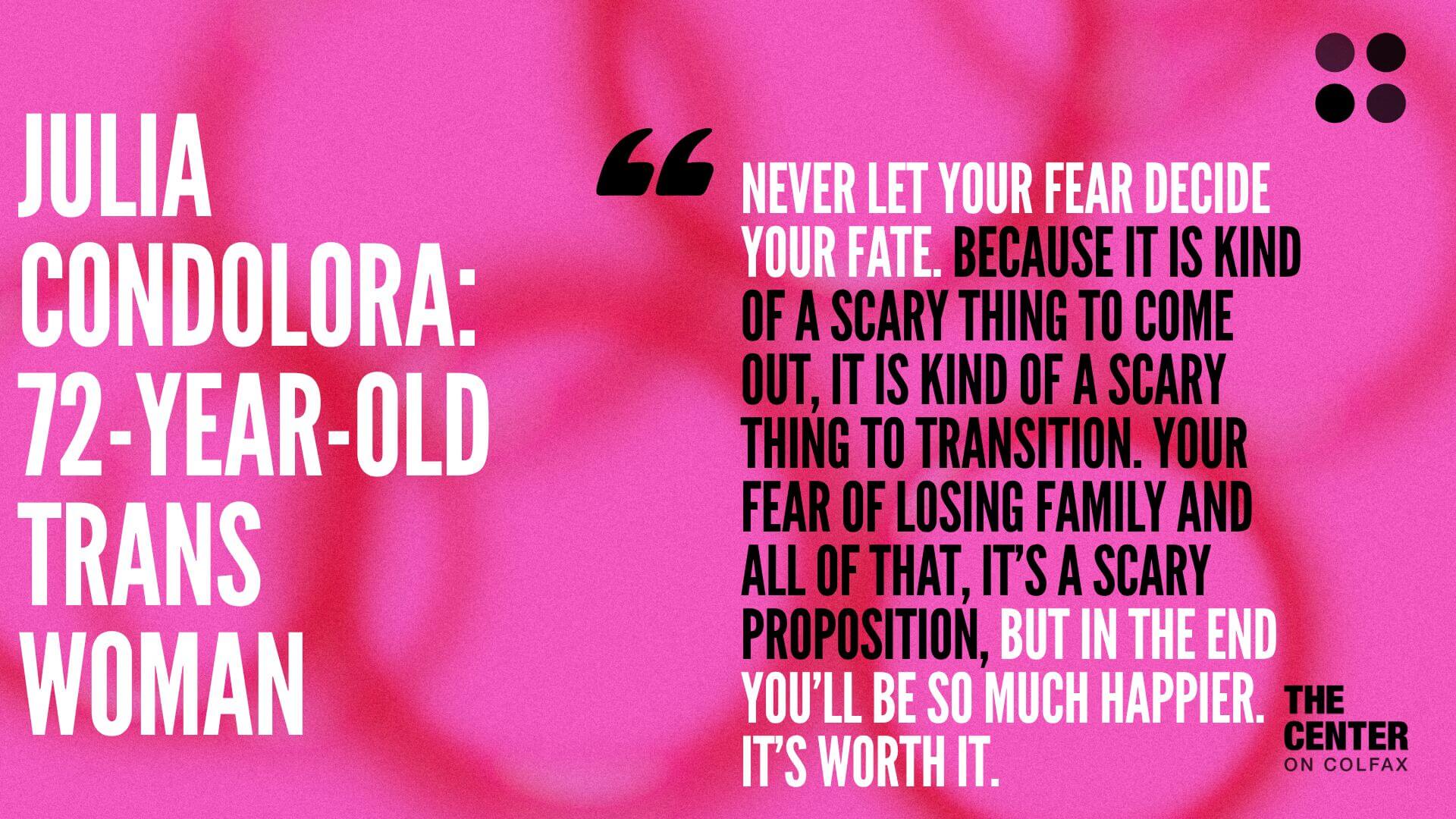
"It is kind of a scary thing to come out. It is kind of a scary thing to transition. There's the fear of losing friends and family — all of that. It's a scary proposition. But in the end, you'll be so much happier. It's worth it."
The Center on Colfax is hosting the International Transgender Day of Visibility celebration on March 28 at Dry Clean Only. Free and low-cost gender-affirming services will be available. All are welcome.
The Center also offers completely free programs and support groups to transgender and non-binary people of various identities. Find our schedule at lgbtqcolorado.org.